Is Print on Demand Still Worth It on Etsy in 2027? My Honest Answer

Is print on demand still worth starting on Etsy in 2027? What you actually keep from a sale, what you’re signing up for, and how to tell if it’s for you.
This post is sponsored by Printify. Shop figures are revenue in AUD, not profit. Market price figures are third-party estimates.
Print on demand looks like the perfect Etsy business. No stock, no packing, no post office. But you’ve probably also heard that it’s saturated, the margins are tiny, and everyone’s selling the same t-shirts.
I sell both digital products and print on demand on Etsy. Over the last 12 months my shops have done about $67K AUD in revenue across both, and on the POD side I’ve sold everything from ornaments and t-shirts to blankets, personalised photo books and custom posters. So here’s my honest answer to whether POD is worth starting in 2027: what you actually keep from a sale, what you’re signing up for, and how to tell if it’s right for you.
Why print on demand works on Etsy
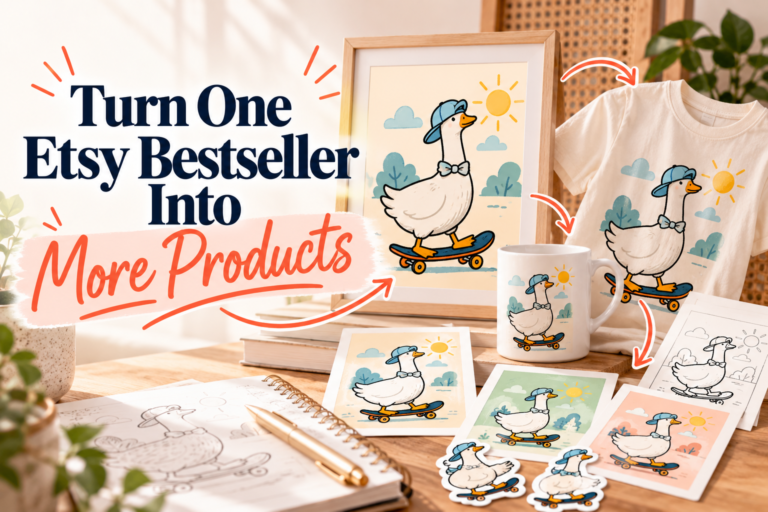
With print on demand, you create the design and the listing. When someone orders, a print partner makes the product and ships it straight to your customer. You never buy stock upfront, so you’re not sitting on boxes wondering if they’ll sell.
On Etsy, that matters even more, because Etsy is a gifting marketplace. People don’t usually go there for the cheapest version of something. They go for something unique, often as a gift, and often with a name, a date or a detail that makes it feel made for them.
That’s where POD has an edge: personalisation. Looking at Etsy market data (October 2026), personalised mugs are listed at around US$16.70 on average, compared with around US$12.50 for funny slogan mugs. Those are average listed prices, not profit, but they show that personalisation gives you room to charge more.
How hard is it to start print on demand?
Honestly, starting is the easy part. There’s no stock and no equipment, and you can get your first product live on Etsy in an afternoon. The decision that matters most is choosing who makes your products, because the printer makes it, but you get the review.
When you’re choosing a print partner as a beginner, look for four things:
- Quality you can check. If a print fades or a colour’s off, that’s your one-star review.
- Shipping you can rely on. A late gift is still your problem.
- A direct connection to Etsy, so orders flow through automatically.
- Range and personalisation, so you can offer the gift-ready products buyers pay more for.
This is why I point beginners to Printify. The catalogue has over 1,300 products, from mugs and journals to wrapping paper, tea towels, pillows, wall art and blankets. For each product, you choose which print provider makes it and compare them on location, production time and price. You connect your Etsy shop once, and when an order comes in, it goes to Printify, they print, pack and ship it, and the tracking goes back to Etsy. It’s free to start.
One tip: always order a sample from the provider you pick before you list anything, so you’ve seen the quality before your customer does.
Print on demand profit: what you actually keep from a sale
Revenue screenshots don’t tell you what lands in your account. Here’s one real order, in USD:
- Sale price (item and shipping): $25.70
- Product cost from the print partner: $6.43
- Shipping to the customer: $9.00
- Etsy listing fee: $0.20
- Etsy transaction fee (6.5% of item and shipping): about $1.67
- Payment processing (as an Australian seller selling to a US buyer, 4% plus about 16 cents): about $1.19
- What I keep: about $7.21, roughly 28%
And that’s before tax, ads, design tools and my time. So it’s what’s left after the order, not take-home profit. Realistically, I’d aim for around 15–20% profit once everything’s counted.
The takeaway: with POD, every sale has to cover the cost of making and shipping a real product, so you keep a much smaller share of the price than it looks. Pricing matters, a big discount can wipe out your profit, and you need to know your numbers before you list anything.
What running a POD shop actually looks like
What the print partner handles: making the product, packing it, shipping it and the tracking.
What you handle:
- Choosing products and checking quality with samples
- Creating listings that make people want to buy
- Customer questions about sizing, delivery times and personalisation
- Sorting things out when a parcel is late or damaged, because your customer comes to you, not the printer
You don’t have to work all of that out alone. Printify’s free Facebook community, Printify POD Rockstars, is full of sellers sharing product and print-quality reviews and answering beginner questions.
Is print on demand too saturated in 2027?
Generic print on demand is crowded, no question. If you sell the same slogan t-shirt as thousands of other shops, you end up competing on price.
But personalised mugs are one of the most crowded products on Etsy, and in October 2026 there were still around 178 personalised mug and cup listings under six months old, each estimated to sell 30 or more a month. One came from a shop that opened just five months earlier and already had nearly 800 sales.
So saturation isn’t really about how many people sell a product. It’s about how many sell the same version of it, to the same buyer. The way in is to get specific: not just a mug, but a mug for a first-time grandma, a nurse who just graduated, or a dad who’s obsessed with fishing. One buyer, one occasion, and a version they can’t find anywhere else.
The verdict: is print on demand worth it in 2027?
My honest answer is yes, if you pick something specific, know your margins and look after your customers. I’m still relatively new to this myself, and it wasn’t too late for me a year ago.
If I were starting in 2027, I wouldn’t compete on generic products. I’d start small with a few personalised, gift-ready products for one kind of buyer, check the quality with samples, learn my margins, then build out from there.
This is the first episode of my Print-on-Demand for Beginners series. Next, I’m showing you exactly how I’d start without paying for extra tools: the beginner products I’d launch first, how to set up personalisation, and how to get it all live on Etsy.
FAQs
Is print on demand still profitable on Etsy?
It can be, but the margins are smaller than they look. On one real order of $25.70, I kept about $7.21 (28%) before tax, ads, tools and time. Personalised, gift-ready products give you more room on price than generic designs.
How much does it cost to start print on demand?
You don’t buy stock upfront. Printify is free to start, and Etsy charges a $0.20 listing fee per listing plus fees when you sell. I’d budget for samples so you can check quality before listing.
Is print on demand too saturated for beginners?
Generic products are crowded. Specific ones aren’t: new personalised mug listings are still selling well on Etsy. Pick one buyer and one occasion and make a version they can’t find elsewhere.
What’s the best print on demand partner for Etsy beginners?
Look for quality you can check, reliable shipping, a direct Etsy connection, and range and personalisation. I point beginners to Printify because it covers all four. (Sponsored.)
Should I sell digital products or print on demand?
I do both. Digital products keep more of each sale. POD lets you sell physical, personalised gifts without holding stock.