How I Made $50,000 on Etsy in 10 Months (Month-by-Month Numbers)

Every month of my first $50K on Etsy, from $0 to $10,251, including the down months, the KDP flop and what I’d do differently.
A little over 10 months ago I started selling digital products online with an 8-week-old baby at home. I had no audience, no existing online business and honestly no idea what I was doing.
Somewhere along the way that little experiment turned into four Etsy businesses, thousands of orders and more than $50,000 AUD in revenue. But it didn’t look like that at the start. It started at zero.
When you look at someone’s business once it’s working, you see the sales. You don’t see the zeros. So this post is every month, including the slow ones, the stores I opened, what I tested and what flopped.
What digital products are (and why I started there)
Digital products are things you create once and sell as a download: printable artwork, templates, planners, invitations, digital designs. A customer can buy them instantly from anywhere in the world, and you never manufacture, pick, pack or post anything.
Etsy is where that started for me. One store, then another, then another, each testing different products, different customers and different ideas. Later I added print on demand, where the product becomes physical but the business still runs online. In my case, all the way from Australia.
My Etsy revenue, month by month
September 2025: $0
Not $1. Not $100. Zero. I was at home with a newborn and a toddler, trying to work out what I could realistically do with very little time. I didn’t know if it would work. I just knew I wanted to try.
October 2025: $157.70
Tiny next to $50,000, but I remember being so excited. For the first time, someone I’d never met in the US found something I made and paid me for it. That was the moment I thought, okay, this might work. I opened my second store that same month, with no idea yet whether that was a good idea.
November 2025: $4,780
This was the month I went, “Oh. This is really a thing.” I started learning fast: what people bought, what they didn’t, which listings got attention and which ones converted. I wasn’t following a perfect business plan. I was following what customers were telling me they wanted.
December 2025: $5,460
Christmas helped, obviously. But something else showed up too. The stores weren’t behaving the same. One was doing really well, one was just starting to take off, and my new third store was still tiny. That’s when I realised I didn’t need one perfect business. I could test different products and customers and let the market tell me what had potential.
January 2026: $4,187
Down from December. This is why I wanted to show every month. If I only showed you the good ones, it would look like the business went straight up. It didn’t. Some months I made more, some months I made less.
February 2026: $3,570
One of the most frustrating points. I’d proven I could make sales, but I had very limited time and two little kids, and I didn’t want to build businesses that just created more work for me. The question became: what’s actually worth my time?
March 2026: $3,494
Still not back to December, but behind the scenes I was getting much more deliberate. Instead of asking “what could I sell?”, I started asking “what’s already selling, why, and can I create something around that?”
April 2026: $2,737
Another down month. If you only looked at revenue, you’d think it was going backwards. But I now had four stores: two digital, a third pivoting from digital into print on demand, and a fourth print-on-demand store on the way. I didn’t know if POD would become anything. I just wanted to test it.
May 2026: $4,163
The print-on-demand experiment started to get interesting. Not enough to say I’d cracked it, but enough traction that, instead of throwing hundreds of random products at it, I built a more deliberate strategy around what I was seeing. That became my pattern: test, find a signal, learn, then double down.
June 2026: $6,574
The pieces started working together. Digital products were bringing in most of the revenue, and POD was starting to contribute. I remember thinking: I’m not just experimenting any more. I’m building something.
July 2026: $10,251
From $6,574 to more than $10,000 in one month. The interesting part isn’t the jump, it’s why. By this point I wasn’t starting from scratch every month. I knew what I was looking for, which products were worth making, and I had several businesses running at once.
August 2026 (to the 14th): $5,900
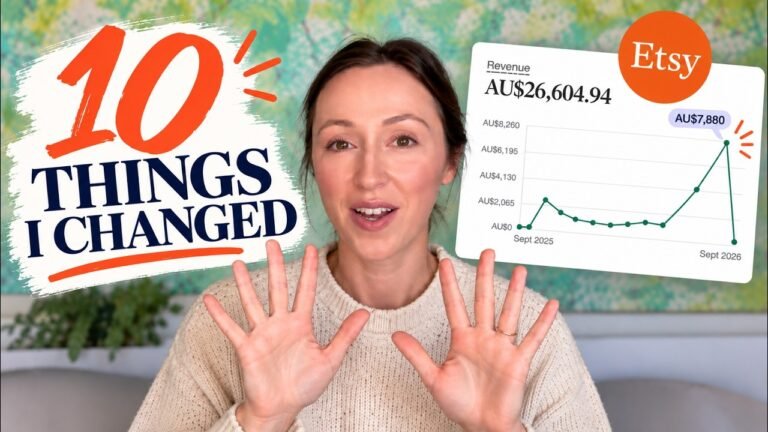
Not even a full month when I filmed this, and already at $5,900. If you want to see how August finished, I broke that down in the 10 changes that took my shop to $7,880 in a month.
Where the $50,000 came from
| Store | Type | Revenue |
| Store 1 | Digital products | Nearly $21,000 |
| Store 2 | Digital products | Over $16,000 |
| Store 3 | Roughly $3,000 digital, $1,000 POD | Just under $4,000 |
| Store 4 | Print on demand | $6,600 USD |
The two digital stores sell AI-generated wall art. If you’re wondering what exactly that looks like and why I think it’s such an accessible place to start, I wrote about it in the digital product that made me $35K.
What didn’t work
I also tried Amazon KDP and made a grand total of around $329 from those books. KDP did not make me rich. I’ve spent hours researching products that never launched, made things that barely sold, and gone down complete rabbit holes.
I think that’s part of the process. You don’t need every idea to work. You need to get better at spotting the ones worth your time.
Why it worked: small things stacking up
It wasn’t one viral product, one huge month or an overnight success. It was one store, one type of digital product, then another, then a POD experiment, then a system that made the next product easier. Eventually those things compounded.
If I had to boil the 10 months down to a few lessons:
- Expect the zeros and the dips. January to April went down before June and July went up. Revenue alone doesn’t show what’s being built underneath.
- Let customers pick your direction. November only happened because I followed what was converting, not what I’d planned.
- Test more than one idea, cheaply. Different stores behaved completely differently. That told me where to double down.
- Build systems early. July’s jump came from not starting from scratch every month.
If you’re starting from nothing, the first real question is what it’ll cost you. I broke down the real cost to start an AI art Etsy shop, from a $0 setup to the ~$200/month stack I use.
The number I care about more than $50,000
When I started, I wasn’t trying to become an Etsy millionaire. I wanted another income stream while I was home with my two kids. Something that worked around my life and could eventually give me more options.
When I go back to work part-time in a few months, these businesses plus my salary will put me ahead of where I’d be going back full-time. That’s the exciting part. I don’t just want more money. I want to buy my time back.
So the questions I’m asking now are different: what can I automate, systemise or delegate? What can I build once and keep improving? How do I earn more without trading more hours? And with Q4 coming, I want to see if I can make the next $50,000 in less than 10 months.
What I’d do if you’re starting now
Start with one store and one product type you understand as a buyer. Expect the first months to be small and uneven. Track every month, including the bad ones, so you can see patterns instead of reacting to one slow week. And once something sells, build around it before chasing the next shiny idea.
If you want the step-by-step version for AI art, my AI Art Starter Guide covers the tools, setup and costs. Or grab the free resources first.
FAQs
How long does it take to make money on Etsy?
For me, the first sale came in my second month ($157.70 in October), and the first big month ($4,780) came in my third. That’s my experience, not a benchmark. It depends heavily on your product, how much you list and how much time you can put in.
Is selling digital products on Etsy still worth it?
My two digital stores have made the bulk of my revenue: nearly $21,000 and over $16,000 in about 10 months. It still takes real work, research and quality, but it’s been the strongest part of my business.
Is print on demand on Etsy profitable?
It’s become a meaningful part of my business. My fully POD store is at $6,600 USD. But it took a few months of testing before I saw a real signal, and margins are slimmer than digital because you’re paying for the product and shipping.
Can you run an Etsy business from Australia?
Yes. All four of my stores are run from Australia, and most of my customers are in the US. Digital products deliver instantly, and with print on demand the supplier prints and ships for you.
Did Amazon KDP work for you?
Not really. I’ve made around $329 from KDP books in total. It can work with the right niche, but it wasn’t where my results came from.




2 Comments