How to Make a Successful Etsy Shop: 10 Things I Got Wrong in My First Year

My Etsy shop sat at $1,500 a month for months. Here are the 10 things I got wrong in year one, and the changes that finally moved it to $7,880.
A year ago, I thought making more money on Etsy was simple. Make more stuff. So I did. More designs, more listings, more late nights after the kids were asleep, tweaking titles and redoing mockups.
And for months, my shop sat at about $1,500 a month. It didn’t move. Then I stopped doing most of that, and in two months it went to $7,880.
So if you’re trying to work out how to make a successful Etsy shop, this isn’t a list of tag tips. These are the ten things I got completely wrong in my first year, the ones you only really learn by running a shop, and what I’d do instead.
Quick context: I opened my first Etsy shop with an eight-week-old and a toddler at home. Today my main business is AI-generated wall art on Etsy, and alongside that I run print-on-demand shops, my own digital guides and a YouTube channel. In my first twelve months, that added up to over 6,000 sales and more than $46K in revenue (I’ve shared the month-by-month numbers here). And I’m finishing this post on holiday with my family in Singapore, which is the part that matters most to me: the business comes with me. It’s not passive, there’s still work, but I can do it from anywhere.
Part 1: Products and demand
1. I thought more products meant more money
My first plan was volume. If ten listings made a few sales, a hundred would make ten times more. Right?
At one point I had over a thousand listings, and somewhere between twenty and fifty of them were actually selling.
Most of my listings were invisible. A handful were doing all the work. What I know now: your first successful product will teach you more than a hundred hours of research. When something sells, stop and ask why. Why this design, this price, this buyer? Then make more of that.
I don’t think the answer is just “list less”. You still need depth and breadth: enough listings for buyers to find you, and enough range to learn what works. But I’d be far more selective. Put out a smaller batch, wait for early signals like views, favourites and first sales, and let those tell you what to make more of, instead of dumping everything in and hoping.
Try this: open your stats, find your top three products, and write down what they have in common before you make anything new.
2. I thought I needed the perfect shop
I redid my first listings over and over, trying to make them perfect, and spent days analysing which one to post first. Which mockup, which title, which order. For listings that almost nobody was seeing yet.
Your first year isn’t about building the perfect shop. It’s about finding signal. You don’t know yet what your winning products are, who your buyer is, or how to position yourself, and the only way to find out is to get things live and read the data.
Try this: good enough and live beats perfect and in drafts. Give yourself a deadline and publish.
3. I thought if I could make it, I should
This one’s sneaky, especially with AI. You can make almost anything in an afternoon. That doesn’t mean anyone wants to buy it. For me, that was reward charts for kids. I’ve got two little ones, I loved making them, and they flopped.
Demand decides, not ideas. Before I make anything now, I check whether people are already searching for it and already buying it (I walk through my full process in how I find AI art to sell on Etsy before it’s saturated). The tool I use for this is EverBee. It shows estimated sales on listings that are already out there, so you see what people are actually buying, not just what they search for.
One hard truth: research can’t save a product that isn’t good enough. If the artwork is close to a raw AI output, or it’s something you wouldn’t hang in your own home, more traffic just means more people deciding not to buy.
Try this: if you can’t find proof that people buy it, treat it as an experiment, not a product line.
Part 2: How a business actually grows
4. I thought Etsy SEO was the whole game
SEO matters, and I’ve written up my whole process for Etsy titles and tags. But in my first months I treated it like the only thing. If a listing wasn’t selling, I’d rewrite the title. Again. And again.
Search is one way people find you. It’s not the business. On my shop today, Etsy search is only about 11% of my traffic. Some of my best traffic came from outside Etsy search completely (I break that down in how I get free traffic to my Etsy shop without paying for ads).
If something isn’t selling, work out which problem you actually have:
- Views but no clicks: usually your thumbnail or price.
- Clicks but no sales: usually the listing itself.
- No views at all: that’s the one that’s actually an SEO problem.
Rewriting the title only fixes one of the three. (More on diagnosing this in Etsy shop not selling? It’s probably not your SEO.)
5. I treated every product as a brand-new project
This is the big one. Every time I wanted more sales, I started from zero. New idea, new design, new listing. It was exhausting.
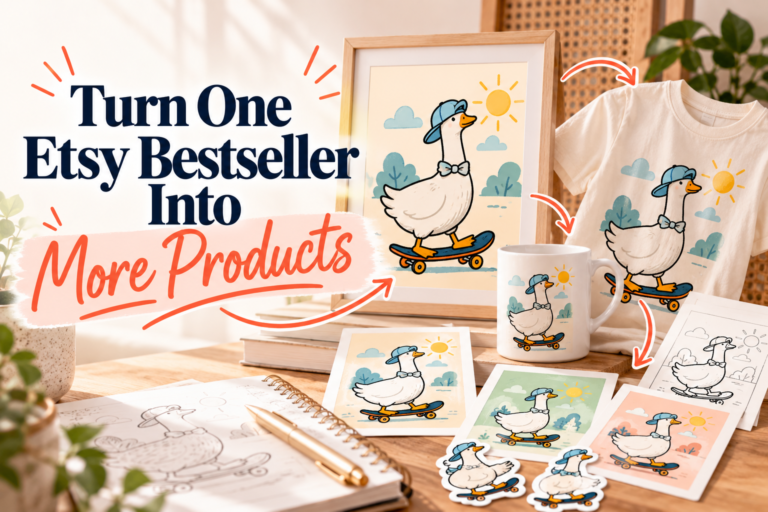
Then I realised that one piece of artwork that’s already selling isn’t one product. It’s an ecosystem. It can be a bundle. A commercial licence. Print on demand, on mugs, blankets and wall art. It can go on Creative Fabrica. It can become a journal cover, or even wrapping paper.
Print on demand has become a big part of that for me. I use AnywherePOD, which lets me set one design up as artwork variations across lots of products in bulk, with the mockups made automatically. It also handles personalisation, so a buyer can add a name or their own photo, which I’d always avoided because the fulfilment felt too fiddly.
The biggest shift in my thinking this year was going from “What else can I make?” to “What else can I do with what I’ve already made?”
Try this: take your best-selling design and list three other formats it could become.
6. I thought busy meant progress
That plateau at $1,500 a month wasn’t from being lazy. I was working constantly. But almost all of it was one job: making.
Running a shop is five jobs: create, market, sell, analyse, improve. I was doing one of the five and wondering why nothing moved.
Here’s what actually changed in the two months before the $7,880 month. None of it is exciting on its own; it worked because I stacked it. I showed up every day, even if it was twenty minutes after bedtime. I checked my own numbers as often as I checked other people’s shops. I cut listings that had sat at zero for months. I turned my winners into bundles and variations. And I put money back into the shop before it felt comfortable: better research, better mockups, better tools (like the automation I use to list AI art in 2 clicks). All ten of those changes are in how I took my Etsy shop from $1.5K to $7,880 a month.
Try this: look at last week honestly. How many hours went to making, versus the other four? If it’s ninety percent making, that’s your answer.
7. I thought diversifying meant doing more things
Everyone says you need multiple income streams, so I tried to do everything at once. I opened too many shops in too many styles, then added too many product types on top. I was completely overwhelmed, and none of the shops got enough of me.
Diversification works after you’ve found something that works. Find the thing with proven demand first, then build around it.
Try this: don’t add a new platform or product type until one thing is reliably selling.
Part 3: The mindset stuff nobody warns you about
8. I thought I could figure it out alone, for free
Etsy can be really isolating. You see your own sales, your own views, your own bad days, and it’s so easy to catastrophise.
You need people who are doing it too. Not for motivation, but for benchmarks, sanity checks, and someone to say “yeah, my views dropped this week too.” And free information is amazing, but it won’t answer everything. Sometimes paying for someone’s framework saves you six months of their mistakes. Just be picky about what you buy.
9. I thought a flop meant I was bad at this
When a listing flopped, I took it personally. When one took off, I thought I’d cracked it. Neither was true.
Products are experiments. Some work, most don’t, and that’s the process. Your strategy will change too. I started thinking Etsy would be my one income channel, and that my artwork would get me out of the nine to five. Now I’m building well beyond Etsy: print on demand, multiple income streams, and each one run like a proper business with its own numbers and its own plan. Your original plan isn’t a contract. Follow the evidence.
10. I thought I was building an Etsy shop
This is the one I’d tell my year-ago self first. I thought the goal was Etsy sales. But look at what actually got built: products, designs I own, knowledge about my buyers, skills, a YouTube channel, an email list, systems.
Etsy is one place I sell. It’s a channel, not the whole asset.
Try this: this month, start building one thing you own outside Etsy. An email list, Pinterest, a YouTube channel. Anything that isn’t rented.
What I’d do if I were starting again
You don’t need to get it all right in year one. Get products live, pay attention to what sells, and do more of that. Then, once something’s working, ask what else you can do with what you’ve already made.
If you’re just getting set up, I’ve also broken down what it really costs to start an AI art Etsy shop, and my AI Art Starter Guide walks you through launching one. You’ll find my free Etsy guides and checklists here, and every tool I use for research, design and selling is on my tools page.
FAQs
How long does it take to make a successful Etsy shop?
There’s no fixed timeline. My shop sat at about $1,500 a month for months before it moved, and what changed it wasn’t time, it was shifting from making more products to marketing, analysing and improving the ones already selling. Treat your first year as finding signal.
Why is my Etsy shop not selling?
Work out which problem you have first. Views but no clicks usually means the thumbnail or price. Clicks but no sales usually means the listing. No views at all is the one that’s actually SEO. Rewriting titles only fixes the last one.
Should I keep adding new listings to get more sales?
Not by default. At one point I had over 1,000 listings and only 20 to 50 of them were selling. Study your best sellers and expand those (new formats, bundles, variations) before starting from scratch.
Is Etsy SEO the most important thing?
It matters, but it’s one way buyers find you. Some of my best traffic came from outside Etsy search, so build other channels like Pinterest, email or YouTube too.
When should I add more income streams?
After one thing is reliably selling. Diversify around what’s already proven, not by doing more unrelated things at once.