Etsy Shop Not Selling? It’s Probably Not Your SEO

No views, no clicks or no sales? Each is a different leak with a different fix. Here’s how to diagnose yours, using my own shop’s traffic data.
If your Etsy shop isn’t selling, your instinct might be to rewrite the title, change the tags and try again. But there are really three different problems it could be, and each has a different fix:
- You’re barely getting any views.
- You’re getting views, but almost nobody clicks.
- People click, then leave without buying.
By the end of this post you’ll know which one you’ve got and what to do about it.
For context: I started selling AI art on Etsy almost 12 months ago and have done more than 5,500 sales. Before any of this, and still today, I work in marketing. This post borrows one simple marketing concept, the conversion funnel, to help you diagnose your shop.
First, my real traffic numbers
When I started, I couldn’t believe how slow my organic reach was. I was sure something was broken. It wasn’t until I talked to other sellers that I realised this was normal, and nobody really talks about it.
Etsy doesn’t publish what “normal” traffic looks like, so I’m sharing my own shop’s split purely as a reference point:
| Source | Share of visits |
| Brought by Etsy (total) | 63% |
| Brought by me (external) | 35% |
| Etsy app and other pages (browse, related listings, “more from this shop”) | About 50% |
| Etsy Ads (money I spend) | 21% |
| Etsy search | About 11% |
It sounds like Etsy is doing all the work. But only about 11% of my total traffic comes from Etsy search. The biggest single chunk is Etsy showing my work to people who weren’t searching for anything specific. Even my ads bring in more than search.
So if you’ve spent three months rewriting titles and tags with nothing changing, search may only ever have been able to influence around a tenth of your traffic.
If your split looks similar to mine or better, SEO probably isn’t your bottleneck. If your search percentage is much lower, it might be. Either way, it’s a reference point, not a rule.
The leaky funnel
Every shop has the same shape. Some leak at the top, where nobody sees them. Some leak in the middle, where people see them but don’t click. Some leak at the bottom, where people click but don’t buy. Same shape, different leak, different fix.
Leak 1: Barely any views
This is the one place where SEO might be part of the problem. But two other things matter just as much.
Catalogue depth. A shop with 8 listings looks completely different to Etsy than a shop with 80. More listings means more chances to be surfaced, more data for Etsy to learn what you’re good at, and more ways into your shop.
The other ~89% of traffic. If you only rely on search, you’re fishing in one pond. Pinterest, an email list and other platforms aren’t optional extras. They’re where a lot of shops get found. I go through each channel I’ve tested in how I get free traffic to Etsy without ads.
To show up more in Etsy’s browse and recommendation spots, what helps is strong click-through and conversion on your existing listings, positive reviews, complete and accurate attributes and categories, and listing consistently. Etsy leans into showing what’s already working. It’s less about one keyword and more about giving Etsy a reason to trust you.
Five things to check
- Count your active listings. Under 30? That’s your first lever, not another keyword tweak.
- Open Shop Manager stats and look at traffic sources. If it’s close to 100% Etsy, fix that first.
- Check click-through and conversion on your best listings. Improving your strongest listings can lift visibility for the whole shop.
- Pick five random listings and check every attribute and category. Fields left on default can make a listing invisible in filtered search, even with a perfect title.
- Be honest about listing frequency. One batch then silence is a signal to Etsy as well as buyers.
When it really is SEO: if views are low across the board, search traffic is close to zero, and you know from research that people are searching for what you make, your title and tags need work. My process for that is in how I write Etsy titles and tags.
Leak 2: Views but no clicks
People are seeing you and scrolling past. That’s a two-second decision problem, not a keyword problem. It’s almost always one of three things: your thumbnail doesn’t match what they searched for, your mockups look generic or too small to read, or the artwork isn’t strong enough to stop the scroll next to five similar shops.
Price can play a role if you’re far outside what similar items cost. But at this stage it’s almost always visuals.
Five things to check
- Search your target term yourself and look at your thumbnail in the results grid, ideally on your phone. Does it look like what your title says?
- Shrink your mockup to thumbnail size. Details that work full size can disappear.
- Put your thumbnail next to five competitors ranking for the same term. Does yours stand out or blend in?
- Compare your price. Being an outlier either way, with nothing in the thumbnail explaining why, can cost the click.
- A/B test mockups on listings that matter. Swap the main image and track click-through over a couple of weeks.
Leak 3: Clicks but no sales
A reality check first. In my experience, Etsy conversion in this space sits around 1 to 3%, with 2% a common benchmark for an established shop. That means out of 100 people who click, roughly two buy. Not ten. Two.
This category also has a lot of window shopping: favouriting, saving for later, coming back weeks later. High favourites and low sales is normal here, not a sign of a broken listing.
But if you’re consistently under 1% across enough traffic to judge, something in the listing isn’t landing. It could be the description, price relative to perceived value, reviews, or the product itself.
And this is the part nobody wants to hear: sometimes the product just isn’t good enough. You can fix thumbnails, pricing, ads and descriptions, but if the product is mediocre, none of that closes the gap. Sometimes marketing isn’t the fix. Making a better product is.
Five things to check
- Look up your real conversion rate in Shop Manager. “Feels low” and “under 1%” are different problems.
- Read your description opener as a stranger. Does the first line match what they searched for?
- Check your reviews, not just the star rating. Newer listings with no reviews ask for more trust than most buyers give on the spot.
- Check price against what the listing visually promises. A $5-looking mockup asking $20 is a mismatch, even if buyers can’t say why.
- Put your listing next to your top three competitors and ask: would I buy mine over theirs? If the honest answer is no, that’s the leak.
The lever most sellers ignore: repeat customers
This isn’t a leak, but it can change everything. A returning customer is cheaper than a new one in every sense: no paying for the impression or the click, no building trust from scratch. And a shop with real repeat buyers sends Etsy a signal a one-off sale can’t.
- Build an email list. The biggest one, because you can reach past buyers outside Etsy’s algorithm.
- Send a real follow-up message after purchase, not just the automatic receipt.
- Attach a small PDF to every download (the one I’d automate): styling tips, a sizing and frame guide, a few complementary pieces, and a soft invite to your email list.
- Add “complete the look” or bundle suggestions to that insert so one sale has an easy path to a second.
- Ask for a review in the same follow-up. Reviews compound trust for every future click.
Quick recap
- No views: catalogue depth and channels outside Etsy search.
- Views, no clicks: your visuals.
- Clicks, no sales: your listing, your price, or honestly your product.
- Underneath all three: bring past customers back.
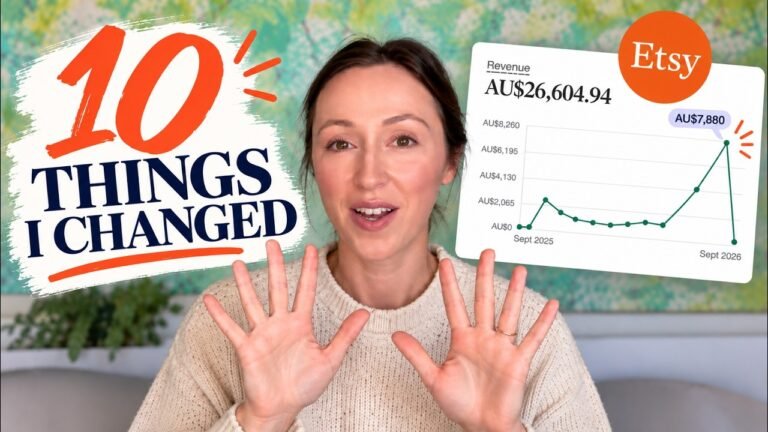
Once you know your leak, the next step is fixing it in order. I put this together in The Etsy Growth Playbook, the same changes behind my shop going from $1.5K to $7,880 a month. Or start with the free Etsy resources.
FAQs
Why is my Etsy shop getting views but no sales?
Check your conversion rate first. Around 1 to 3% is common in this space. If you’re consistently under 1%, look at your description opener, reviews, price versus what the listing promises, and whether your product holds up next to competitors.
What is a good conversion rate on Etsy?
In my experience in the digital wall art space, 1 to 3% is typical, with around 2% common for an established shop.
How much of Etsy traffic comes from search?
In one of my shops, only about 11%. Around 50% comes from Etsy’s app and other pages (browse and recommendations), 21% from ads and 35% from traffic I bring in myself.
How many listings should I have on Etsy?
If you’re under 30 active listings, adding more is likely your first lever. More listings give Etsy more data and give buyers more ways into your shop.
Is Etsy SEO still important?
Yes, but it’s one part of the picture. If your views are low, search traffic is near zero and you know people search for your product, then it’s worth fixing your titles and tags.




3 Comments